In the afternoon we went on a tour to Las Tintoreras with our snorkelling gear. The island was amazing and the water wasn't too cold for snorkelling. On arrival we could see penguins and sea lions on the shore. How incredible to think that penguins can actually live on the equator! We marvelled at them diving into the water and swimming at high speed in front of the tour boats. Ian and I snorkelled over to the penguins and managed to get photos of them out of the water. On the way back to the boat a young sea lion dived into the water and started playing with Ian. By the time I arrived it took off and teased us by diving in and out of the water around us. We all got back in the tour boat thinking it was all over when the driver dropped us off with a group of 3 sea lions. They played with the group and were very curious diving underwater to get a closer look at the humans. At one stage a large marble ray appeared and the sea lions checked that out to play with before thinking better of it and swimming away. After the encounter we were dropped off on Las Tintoreras with Wilmer the guide. We visited the shark channel where white tip sharks rested on the sandy bottom. Huge iquanas sun baked on the island and huddled together to keep warm. As we walked along the trail a curious sea lions came along the sand to inspect the group. We were able to get very close to it and take photos. As the sun set over the island we were sad to get back into the boat. What an incredible day. The next day we got up early and relaxed on the wild beach that ran parallel to the main street. We met some other cruisers who suggested we have a snorkel at Concha Perla. There were 2 big saltwater pools teaming with life including penguins, fish, huge sea stars, rays, turtles and marine iguanas. We were fortunate enough to watch the marine iguanas diving into the water to feed and we had the chance to swim with them as well which was an unforgettable experience. You can see Ian posing with a large marine iguana in the background.
Monday, 13 June 2011
Las Tintoreras Isabella Island
In the afternoon we went on a tour to Las Tintoreras with our snorkelling gear. The island was amazing and the water wasn't too cold for snorkelling. On arrival we could see penguins and sea lions on the shore. How incredible to think that penguins can actually live on the equator! We marvelled at them diving into the water and swimming at high speed in front of the tour boats. Ian and I snorkelled over to the penguins and managed to get photos of them out of the water. On the way back to the boat a young sea lion dived into the water and started playing with Ian. By the time I arrived it took off and teased us by diving in and out of the water around us. We all got back in the tour boat thinking it was all over when the driver dropped us off with a group of 3 sea lions. They played with the group and were very curious diving underwater to get a closer look at the humans. At one stage a large marble ray appeared and the sea lions checked that out to play with before thinking better of it and swimming away. After the encounter we were dropped off on Las Tintoreras with Wilmer the guide. We visited the shark channel where white tip sharks rested on the sandy bottom. Huge iquanas sun baked on the island and huddled together to keep warm. As we walked along the trail a curious sea lions came along the sand to inspect the group. We were able to get very close to it and take photos. As the sun set over the island we were sad to get back into the boat. What an incredible day. The next day we got up early and relaxed on the wild beach that ran parallel to the main street. We met some other cruisers who suggested we have a snorkel at Concha Perla. There were 2 big saltwater pools teaming with life including penguins, fish, huge sea stars, rays, turtles and marine iguanas. We were fortunate enough to watch the marine iguanas diving into the water to feed and we had the chance to swim with them as well which was an unforgettable experience. You can see Ian posing with a large marine iguana in the background.
Isabella Island

We decided to do a 3 day tour to Isabella Island. We paid $140 each for an inclusive boat trip, 2 nights in a pension by the beach and 2 tours. The boat trip to Isabella took 2 hours and it was very bumpy. Lucky we had our fair share of bouncing around on Faraway so didn't get sea sick like most of the other passengers. When we arrived on Isabella the customs officer greeted the group and a Labrador dog ran across all our bags looking for illegal substances. This was quite a surprise but nice that the Government are looking after their peoples best interests. It was late afternoon and we dropped our bags at the hotel, grabbed our cameras and headed out to the Flamingo Pond for sunset. Later on dinner was arranged at a nearby restaurant and we walked along the dirt road into town. This was definitely a town that time had forgot but we were so grateful to be on land that we enjoyed every moment of it. Our room was very basic but we liked it so much that we stayed 1 night longer than our original plan. The next day we were up at 7am for a quick breakfast and a 16km trek up to the Sierra Negro volcano. Unfortunately it was cloudy for most of our walk but we still got to see the caldera and lava tunnels. We also had the opportunity to feel the heat coming out of an active vent. It was Ian's birthday and he seemed to enjoy every moment of the trip. We had an excellent guide called Wilmer who did the walk several times a week and was extremely knowledgable and super fit for his age. We got back to town around 2:30pm and prepared for our next adventure to a nearby island where penguins and sea lions frequented the waters. We were both extremely tired from the walk but couldn't miss the opportunity to do another tour.
Thursday, 9 June 2011
Las Grietas

Today we took the water taxi over to Las Grietas and walked to the crystal clear aqua blue pond nestled in between lava rocks. The water is brackish and it is a breeding area for parrot fish that are trapped there until a big tide can carry them out to sea. The water was freezing cold but extremely refreshing. We had time to sit on a rock and eat our picnic lunch consisting of roast beef sandwiches. It was a slow walk out over lava rocks and along a beautiful sandy beach. Wildlife was abundant and we stopped along the way to check our herons and small waders feeding by the shore.
Feeding Time Galapagos Style
We had a stroll along the waterfront and came across an interesting scene of activity. The fisherman had brought in their catch for the day and a variety of creatures were in on the action. The Pelicans were queued for fish on one side of the counter like customers at a store with humans queued on the other side buying fish. An iguana desperately crawled up the ice box trying to get some of the fish as well. You can see him in the bottom right corner of the first photo. A sea lion rolled around on the sidelines trying to relax in the midday sun but kept getting disturbed by pelicans. On the following day I went back to the market and the sea lion was in on the action leaning over the counter to sample some of the days catch. A blue footed booby bird also appeared with the pelicans being favoured by the fisherman for an easy meal.
Santa Cruz Island
Yesterday we explored the Darwin Research Centre on Santa Cruz Island. We walked to the Giant Tortise enclosure and Ian got friendly with a few of the larger male residents. I really liked the pens where the babies were being trained in different environments so they could be released back to islands in a few years time. We think the tortise in the photo with the long neck is Lonesome George. He was one of the remaining survivors from an island where longer necks were required to feed on vegetation that was growing at a higher level than the other islands where tortises had regular necks. A living example of Darwin's Theory of Evolution. The park had a very interesting visitors centre and we spent hours wandering around and enjoying the unusual natural environment of cactus and lava rocks.
Galapagos Islands

We finally arrived in this amazing island chain on the afternoon of Sunday, June 5 after a 7 day horrific passage from Cocos Island. We planned to sail the 440 nautical mile route in 3 days but unlucky for us the seas were rough and we had a current and head swell against us for the first few days. The worst factor was that the winds were against us. We virtually had to sail towards Equador until we could point at the Galapagos Islands. We felt sorry for our passenger Pascal who hadn't really sailed before as this was the hardest crossing that we had encountered so far on our journey. Ian and I had to battle in the kitchen below to try and cook appetising meals that we didn't really feel like eating and wash up afterwards. It was hard just standing up in the galley let alone cooking anything. Having a shower and going to the loo were also challenges and you had to have a good grip on the hand rails. We shared the night watches which were pretty miserable at the start of the trip as it seemed to rain all night and once again our canopy leaked with cool drips of water. We were all exhausted trying to catch sleep when we could during the day and night. Faraway rocked and rolled in the swell and we mainly slept, read, trimmed the sails and counted the miles. We first caught sight of these mysterious islands on Saturday afternoon June 4. In the distance Genovesa Island came into view. This island is famous for the huge bird colonies. We sailed past with just one more night to go before reaching our anchorage in Academy Bay on Santa Cruz Island. On my watch at 2:09am on Sunday morning we finally crossed the equator officially into the South Pacific. We didn't really have time to celebrate but it was a relief to be leaving the seemingly hostile waters of the North Pacific. We motored into Academy Bay not sure what to expect but the anchorage looked amazing and we could see cactus lining the rocky shoreline. The navy came on board and we cleared in with them and a representative from Global Ocean Services (GOS). After that we were free to go ashore and I wasn't disappointed. Pascal, Ian and I took the dinghy over to the jetty and I was met by a huge sea lion that I had to ask to please move out of the way! I then bumped into a marine iguana and a land iguana and a huge pelican all in the time frame of about 5 minutes. I soon realised that we had arrived somewhere really very special. I also knew that my camera wasn't going to have much of a rest while we were in the Galapagos.
Thursday, 2 June 2011
ISOLATED
Well we made it to Cocos on Friday, May 27. It was a hard slog -we motored nearly all the way to Cocos Island and burned 550 litres of diesel, changed 2 primary and 2 secondary fuel filters etc...Was it worth it-YES. The Cocos Island is amazing. It was just like stepping into Juarassic Park. We arrived just before sunset. Although we arrived in Chatham Bay at the most sheltered anchorage first, we had to continue to Wafer Bay and clear in. It was a very gloomy sunset and the sea was rolly and uninviting. We motored around the bay but decided it was unsafe to anchor. We quickly motored back to Chatham bay. The water was dark and it was difficult to decide which was sand, rock or coral.There were 3 liveaboard dive boats and a Danish Catemaran all on mooring balls. We called the cat and they advised us to take a spare mooring ball as there were no other dive boats due. Although it was getting dark the thought of becoming shark food did not deter us from jumping into the sea and refreshing after the horrific journey. I swam to the cat to say hello but Sheryl got straight out as the North Pacific does have a murky look and she thought there would be schools of hammerheads underneath her. There was a guy from Switzerland called Pascal visiting the cat-he was from the dive liveaboard and was looking for a lift to Galapagos. He is travelling the Pacific and trying to make articles on diving for publishers. Sheryl and I decided originally not to take on passengers or crew but Pascal seemed very interesting and we realised that an extra person for night watch is useful-so we invited him along.
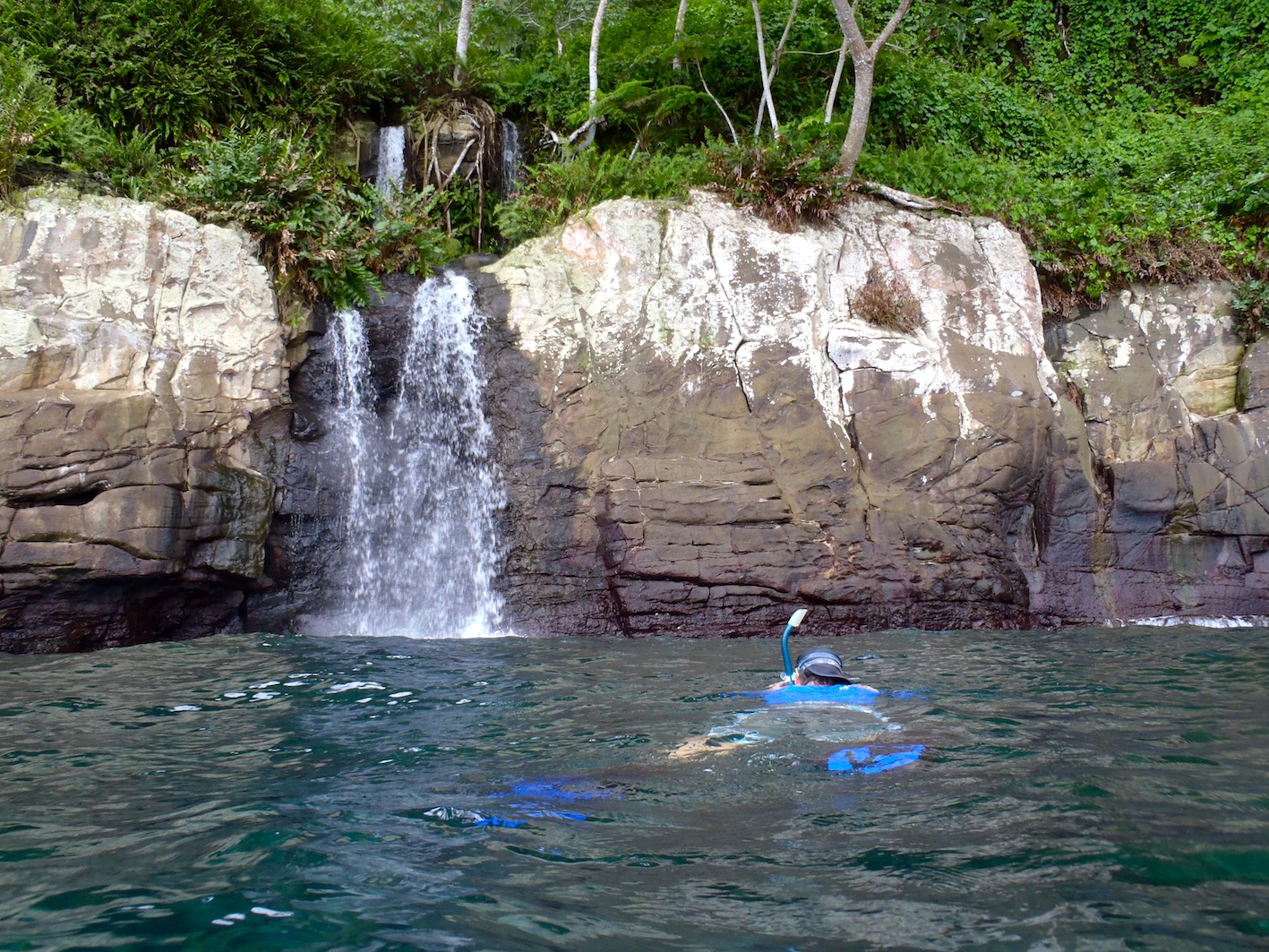
On our first morning in Cocos the torrential rain finally stopped and we woke up to a beautiful sunny day. The scenery was spectacular with sheer cliffs cloaked in lush green rainforest. A variety of sea birds clung to rocky outcrops and sat in the trees on the shore when they weren't soaring above us. I kayaked over to the 'Agressor' liveaboard to enquire about diving with them. The Captain said 'no' which was disappointing as the rangers had told us it wasn't safe for the 2 of us to dive alone as a few weeks ago a diver had been swept 3 miles out to sea in a strong current and he was with a guided group. Luckily he was eventually found by a search party of 5 boats. Ian and I decided to go snorkelling instead and enjoyed gliding over small white tip reef sharks and checking out the unusual marine life. We pottered around in the dinghy next to the cliffs and checked out several waterfalls that were spilling into the sea. In the afternoon we kayaked to shore and climbed up to a lookout at the top of the hill. We had now mastered the art of surfing our kayaks onto beaches and paddling out into rolling waves. It was very hot and humid on land but we had a lovely view of Chatham Bay and the birds were now soaring at eye level with us. We sat for a long time taking in the view when all of a sudden we heard a rustling noise in the bushes. Expecting some wierd creature to emerge we poised our camera at the bush. To our surprise 2 rats sprang out of the bush and jumped across in front of us. Ian managed to take a photo of the rat at the same time as it poked it's tongue out at us. Nice.
There was another liveaboard dive boat moored in the bay next to us called 'Sea Hunter'. Not to give up easily on the diving we took the dinghy over to enquire about diving with them. The divemaster said he could organize a guide for us the next afternoon to do 2 dives on Melorita Island. I was really looking forward to seeing some hammerheads as they were known to frequent the rock in the strong currents. The guide called Esteban was excellent-from the moment he greeted us when we visited the boat the previous day until the crew picked him up after our dive, he was so enthusiastic.and extremely knowledgeable. He did have bad news for us- there was no chance of seeing a red lipped batfish as he had only seen 1 out of 12 dive trips to the island. Like all good plans we didn't get off to a good start. We had to motor our dinghy around to Sea Hunter to pick up the guide. Once we had him and all his gear on board as well as ours we headed off with our 10 horse power engine to the dive site. We got about half a mile away from the Sea Hunter when our engine died. Luckily the Sea Hunter was still in sight but we couldn't get their attention. We called them on the radio, held up a dive sausage and whistled for help. Ian and the guide called Steban started rowing the dinghy as we were getting swept by the waves into the rocks. Finally the Sea Hunter saw us and sent a boat to the rescue. The mechanic from Sea Hunter fixed our engine and after about half an hour we set off to the dive site. We couldn't dive the rock as the current was too strong so we went to a small bay for the first dive. It was very nice and we saw loads of white tip sharks, 2 marbled stingrays and a variety of reef fish. The guide spotted 2 Harlequin Shrimp which were very beautiful and a rare find. Unfortunately I but spiked my hand on a sea urchin (I pulled around 20 spines out of my hand while underwater, but many broke and remained under the skin-mainly the ones Ian pulled) in the process of taking the photo of the little critters that were wedged under a rock ledge. For the second dive the guide took us to Melorita rock.It was on the open ocean side of the rock-all other boats were gone and it was just us in the little dinghy with the unreliable 10hp engine. The swell was big and the waves thundered onto the rocks and cliffs only 20 metres away. It was late in the afternoon. it was getting darkish and the sky was gloomy when we jumped in the dark water. The guide assured me that once below it would be calm. Ian stayed on the dinghy as safety cover-he motored to 1 end of the rock-switched off the engine and drifted in the strong current before going back again-he was completely surrounded by the wild North Pacific and the many creatures that exist there-he saw a stingray jump out of the water nearby and many schools of fish feeding on the surface. He was always concerned that the engine would fail and he would drift to sea. There was only a little current below and we swam to the cleaning station where the hammerheads come in to be cleaned by small fish. Unfortunately they were out for the day. We didn't see any hammerheads just an eagle ray and more whitetip reef sharks. At the end of the dive Esteban allowed the dive sausage to surface as we drifted in the current below. This allowed Ian to strategically place the dinghy for a pick up.
I was a bit disappointed that I had not been able to really see the underwater world of this wild island as the next day we were leaving. The good news was that our new crewmate Pascal was waiting for us when we got back to Faraway. Pascal helped us to get ready for the next sailing adventure to the even more mysterious Galapagos Islands. After a rolly nights sleep and a quick dip in the ocean we headed south east into the wild blue..........
Subscribe to:
Posts (Atom)